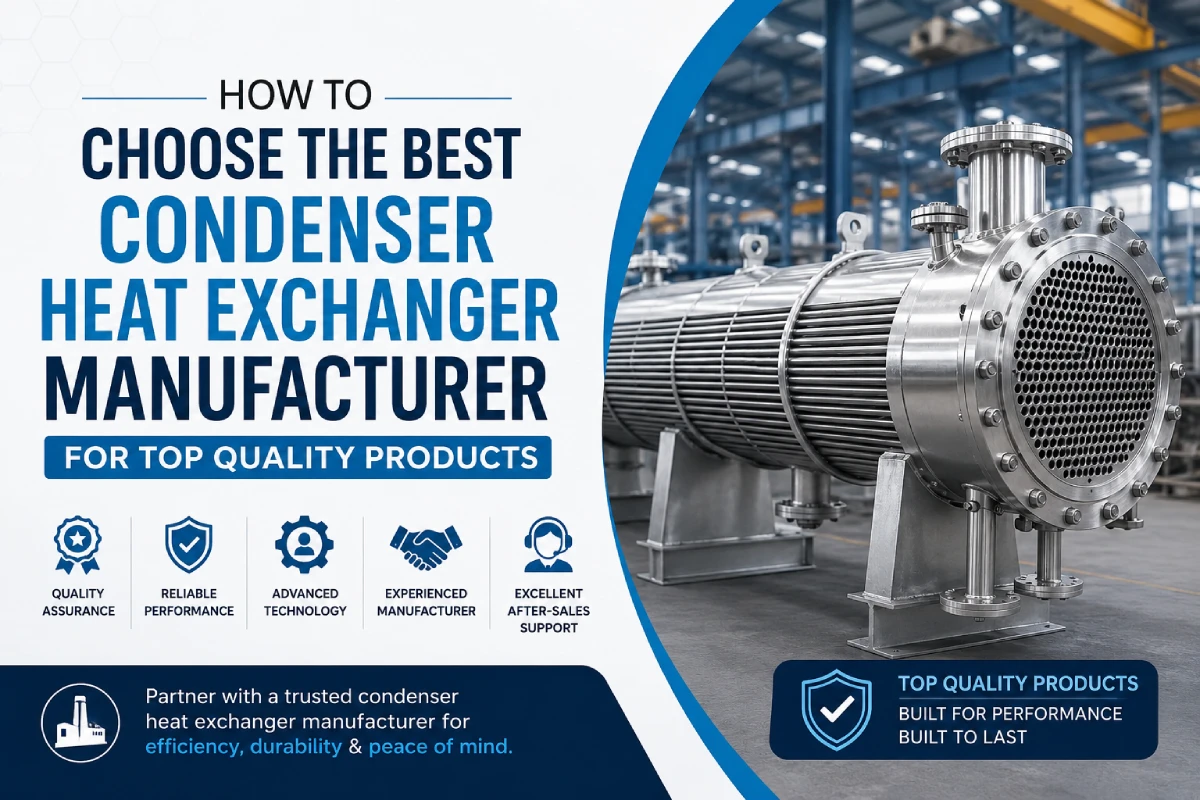
Choose the Best Condenser Heat Exchanger Manufacturer for Top Quality Products
Selecting a reputable condenser heat exchanger manufacturer is imperative for organizations looking to enhance their operations through efficient thermal systems. Even though heat exchangers and condensers are popular industrial products, they are used from household use to chemical manufacturing plants. Condenser heat exchangers occupy an important position as they not only conduct the exchange of heat. But they also turn the vapor into liquid form in applications such as power stations, petrochemical industries, and refrigerators. It can be effective in residential areas, or maybe in your homes.
With increasing demand in the industry, the condenser heat exchanger manufacturer has become prominent for their specialization in supplying reliable and durable products. On the other hand, general heat exchanger makers offer a wide range of equipment in terms of their services and heating/cooling capacity. This knowledge is vital for buyers to consider when making a purchase. Moreover, this guide will help you clearly understand these two pieces of equipment and their functions.
What is a Heat Exchanger & Its Types?
A heat exchanger is a device that passes the heat between two liquids without changing their state. It is an apparatus that recovers the heat produced during condensation. The heat exchanger is usually used for heat recovery. The process involves the transfer of heat between two states, from the higher- to lower-temperature liquids. These are separated by a solid barrier that prevents them from mixing or coming into contact. Heat exchangers can be found in a wide range of equipment.
These include refrigerators, power stations, petrochemical complexes, gas plants, space heaters, air conditioners, chemical complexes, petroleum refineries, and wastewater treatment systems. Here are a few real-life examples of heat exchangers:
- The internal combustion engine is the first example used when talking about heat exchangers. In an internal combustion engine, a fluid known as engine coolant passes through the radiator coils. On the other hand, air will pass through the coils, heating the air while cooling the coolant.
- Heat sinks are another type of machine used to demonstrate heat exchange. Heat sinks are passive heat exchangers. By using such machines, heat generated from mechanical and electronic systems is dissipated into a fluid medium. The fluid medium could be either a liquid coolant or air.
Four Main Types of Heat Exchangers
The heat exchanger manufacturer has categorized its types and designs based on their usage in applications. Therefore, they might function differently, have distinct shapes and sizes, or be used in various areas. But they are all exchangers.
1. Double Tube Heat Exchangers
It is designed as one tube inserted into another, with the inner one carrying fluid and the outer one carrying another. However, its simple design makes cleaning easy and is best for small-scale or low-pressure applications. Common in food, dairy, and small chemical processes.
2. Shell and Tube Heat Exchangers
It is one of the widely used types that follow a design with a bundle of tubes inside a cylindrical shell. In this type, one fluid flows through the tubes, the other around them in the shell. Handles high pressure and temperature, ideal for petrochemical, power plants, and refineries.
3. Tube in Tube Heat Exchangers
It’s like a double-tube heat exchanger but generally wound into coils. In it, the inner tube contains the product, while the outer tube contains the heating/cooling agent. They are popular in sanitary applications such as beverage, milk, and drug manufacturing.
4. Plate Heat Exchangers
A heat exchanger consists of thin metal plates arranged in layers, making them efficient because of their high surface area despite being small. Used in HVAC, refrigeration, and food processing systems.
What is a Condenser & Its Types?
The condenser is a type of heat exchanger. However, the key distinguishing characteristic is that, whereas heat exchangers transfer heat between two fluids, condensers condense gas into liquid form through cooling, thereby releasing latent heat absorbed by the surroundings.
Condensers vary widely in size, from the small condensers in household equipment to the massive condensers in power generation stations and chemical industries. Examples of everyday condensers include refrigerators and air conditioning units, which condense heat from their interiors to the external environment. Condensers are essential pieces of equipment in industrial operations such as power generation, distillation, and chemical processing.
The 3 Types of Condensers
The condenser heat exchanger manufacturer has designed these condensers into various styles and sizes. The three main types of condensers are listed below:
1. Air-cooled Condensers
Uses the surrounding air as the cooling agent.
The heat energy is released directly into the environment.
Commonly used in refrigeration units, air conditioners, and other applications where water is not available in sufficient quantities.
Advantage: Does not require water.
Disadvantage: Ineffective in tropical environments.
2. Water-cooled Condensers
Use water to transfer and dissipate heat energy.
More effective compared to air-cooled condensers, particularly in heavy industrial installations.
Used in power stations, chemical industries, and large HVAC applications.
Advantage: Effective cooling mechanism.
Disadvantage: Needs a constant supply of water and maintenance.
3. Combined Air and Water-Cooled Condensers
Uses both air and water for cooling purposes.
Combines the advantages of air- and water-cooled condensers in a single unit.
Typically used in industrial processes that demand maximum dissipation of heat.
Advantage: Efficient in diverse situations.
Disadvantage: Complex design and high installation cost.
Difference Between Heat Exchanger and Condenser?
The condenser and heat exchanger manufacturer has designed these two pieces of equipment to smoothly handle these heat exchanges, regardless of changes in form. Or just the heat transfer from one substance to another.
| Aspect | Heat Exchanger | Condenser (Heat Exchanger Type) |
|---|---|---|
| Purpose | Transfers heat between two fluids (liquids or gases) without changing their phases. | Converts vapor/gas into liquid by cooling. |
| Process | Heat moves from hot fluid to cold fluid through a solid surface. | Latent heat is released during condensation and transferred to the surroundings. |
| Cooling Medium | Depends on design — may use air, water, or another fluid. | Usually air, water, or a combination of both. |
| Types | Double Tube, Shell & Tube, Tube‑in‑Tube, Plate Heat Exchangers. | Air‑Cooled, Water‑Cooled, Combined Air & Water‑Cooled Condensers. |
| Applications | Power plants, petrochemical units, HVAC systems, and food processing. | Refrigerators, air conditioners, steam power plants, and distillation systems. |
| Scale & Design | Ranges from compact to large industrial units; design varies by fluid type and pressure. | Available from small household units to large industrial condensers, the design depends on the cooling method. |
| Key Difference | Focuses on heat transfer only. | Focuses on phase change (vapor → liquid) while transferring heat. |
Concluding Here!
A condenser and heat exchangers manufacturer is a figure that produces and supplies these crucial components that ensure maximum efficiency. Therefore, these are used in temperature regulation in both residential and commercial applications. At the same time, all condensers qualify as heat exchangers due to their exceptional ability to turn vapor into liquid. Making condensers is essential for industrial processes.
Selecting an appropriate condenser heat exchanger supplier will ensure durability, efficient operation, and long-term energy savings. From air-cooled to water-cooled condenser heat exchangers, the choice depends on your requirements and application needs.
If you’re looking for a supplier and are confused by the options, look no further than Kwality Process Equipment Pvt. Ltd. Contact us today for more details.
FAQs
Ans: We serve various industries, and our products are suitable for many of them also. The industries we serve include chemical, petrochemical, paint, pharmaceutical, sugar, and food industries, with installations in India and abroad. You can contact us to learn about delivery and product specifications for your city.
Ans: All our manufactured products comply with various market standards, as we use only stainless steel. In addition, all our products are designed in accordance with ASME, TEMA, DIN, and BS international standards. Thus, you can be assured of safety, durability, and reliability with our products.
Ans: The portfolio of Kwality equipment includes the pressure vessels, reactors, heat exchangers, condensers, columns, storage tanks, mixers, and continuous nutrition systems. For further details, contact our support team. They can assist you with full details.
Ans: Yes, we do both national and international services, from product supply to customer support. You can take on our services from any corner of the world.
Ans: Our policy quotes “customer loyalty is our goal.” Therefore, focus on delivering quality products on time and at competitive prices, with strict quality control and an emphasis on safety.